
Why Restore the Kennebec?

A river at the heart of Maine

For thousands of years, the Kennebec River has been the lifeblood of Central Maine. From Moosehead Lake to Merrymeeting Bay and out to the Atlantic, it has sustained people, wildlife, and historic runs of native, sea-run fish that rivaled anything on the Eastern Seaboard.

Tens of millions of these fish – including American shad, river herring and Atlantic salmon – returned to spawn in the Kennebec watershed every year before heading back to the ocean. This natural migration helped sustain enormous fisheries in the Gulf of Maine, such as cod, as well as other wildlife and birds, like eagles and osprey.

During the past two centuries, dams have been built on the Kennebec to provide hydropower – lots of it. Today, the river and its tributaries host 20 hydroelectric dams.
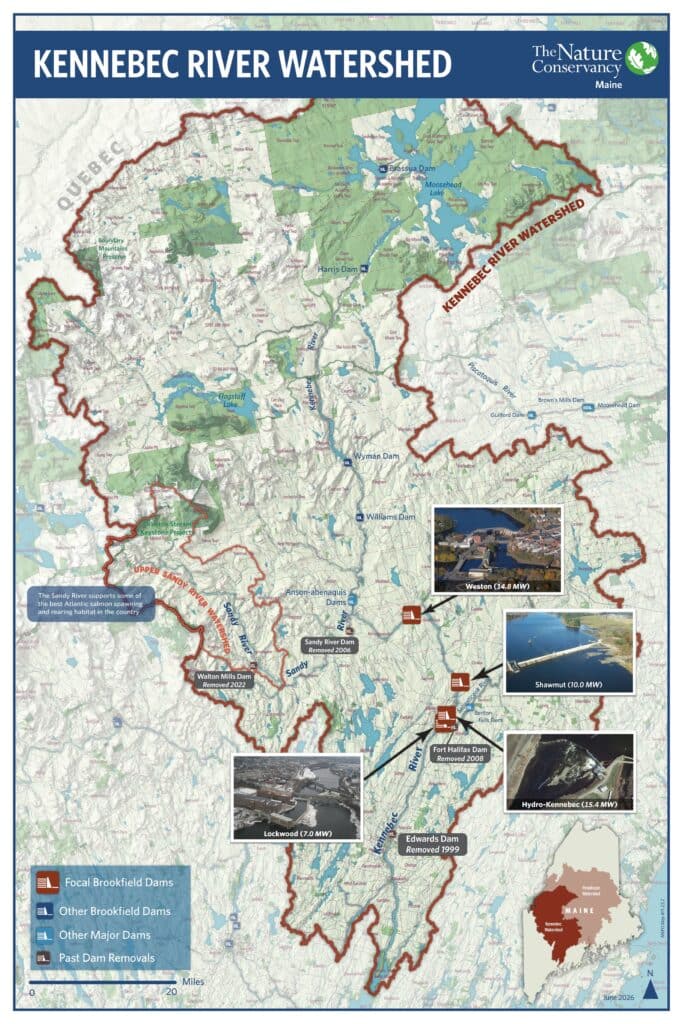
An historic opportunity

In September 2025, The Nature Conservancy and Brookfield announced an agreement for the sale of the four lower dams on the Kennebec River – Lockwood, Hydro-Kennebec, Shawmut, and Weston. The purchase of the four dams by the Kennebec River Restoration Trust is expected to be finalized next year. Following the sale, Brookfield will be contracted to continue supporting operation of the hydro facilities, which will continue to operate safely, supply power to the grid, and provide tax revenue to communities.

The longer-term vision of the Trust and our partners is to reconnect the Sandy River to the Gulf of Maine by restoring free-flowing conditions to this section of the Kennebec. We intend to manage the multi-year river restoration and redevelopment process in close collaboration with local communities, and are 100% committed to developing a plan with Sappi to ensure the Somerset Mill’s water system needs are fully addressed before any changes are proposed at the Shawmut Dam.

The Kennebec can be home to one of the largest river restoration efforts in the nation, reconnecting over 800 miles of some of the country’s best river and stream habitat. Through thoughtful collaboration, it can be done in a way that provides economic benefits to towns along the river, from municipal revenue to local jobs, while supporting ecological benefits to fish populations and the communities that depend on them.

Answers to Common Questions

In Maine, the benefits of river restoration are well known. Along the Kennebec, rebounding fish populations and benefits to local economies have been evident since the removal of the Edwards Dam in 1999. On the Penobscot River, the removal of the Veazie and Great Works dams demonstrated the immense potential for river restoration to improve ecosystem health and advance river-dependent economies, cultures, and livelihoods.

The Kennebec can be home to one of the largest river restoration efforts in the nation, reconnecting over 800 miles of river and stream habitat. Potential benefits include:

  • The opportunity to restore a population of endangered Atlantic salmon and support the 11 other species of sea-run fish native to the river
  • Improved health of fisheries in the Gulf of Maine
  • Reduced likelihood and severity of extreme flooding near currently impounded sites along the river
  • Support for community economic revitalization
  • Enhanced river access, outdoor recreation, and cultural reconnection

The Trust and our partners are 100% committed to developing a solution with Sappi that fully addresses the Somerset Mill’s water system needs as part of any long-term restoration plan. We have conducted substantial engineering analysis and are confident there are a range of solutions that can address the mill’s needs and provide safe, timely, and effective passage for sea-run fish like endangered Atlantic salmon. No plan to decommission the Shawmut Dam will be advanced until a solution is identified that achieves both of these goals. Such a solution is not only possible, it is necessary. Once a viable solution is identified, the Trust and our partners are ready to raise funds to make it a reality.

On its company website, Sappi shares its commitment to this process as well: “We are working collaboratively with TNC to find a solution that addresses the Somerset Mill’s water needs. … We are committed to working with TNC to find a solution that protects both the health of the Kennebec River and the nearly 800 jobs that depend on this mill.”

River restoration is a multi-year process that will require significant planning in collaboration with local communities. No major changes can be made at the four lower Kennebec dams until decommissioning plans have been approved by the Federal Energy Regulatory Commission (FERC). The precise timing and phasing of decommissioning will be determined based on engineering, the stakeholder engagement process, FERC approval and other factors, and will likely be phased over the next 5–10 years.

During that time, the Trust and the Advisory Council will continue to work with municipalities, businesses, Tribal Nations, agencies, riverside property owners, nonprofits, and communities on a wide range of important issues, from flood risk reduction and energy infrastructure to outdoor recreation and property redevelopment opportunities. The dams will continue to operate safely, supply power to the grid, and provide tax revenue to communities throughout this process.

For the next several years at least, the dams will continue to operate and provide tax revenue to communities. During that time, a working group of the Trust’s Advisory Council will work with towns and experts to develop a plan to ensure municipal revenue stability through the restoration process and beyond.

These dams will continue producing electricity for at least the next few years, and in most cases longer. Beyond that, the Trust and our partners are committed to pursuing new opportunities for renewable energy production and battery storage at these sites, to be phased in as the dams are decommissioned. This will be the focus of an Advisory Council working group.

No. The Kennebec is one of Maine’s largest rivers; even in a dry year like 2025, more than 900 million gallons of water flowed past Skowhegan and Waterville on an average day. These dams are all “run-of-river” facilities, meaning they are required to let through the same quantity of water that flows to them from natural runoff and releases upstream. Dam removal will have no effect on the amount of water in the river.

The best way to picture how the Kennebec might look after a dam removal is to look directly downstream from one of the dams, where the river is already free-flowing. The impounded areas directly upstream of each dam are currently higher than they naturally would be, so these stretches of the river will look different following restoration. The Trust is committed to working with riverfront property owners to understand any impacts and the options available for addressing them, and a working group of the Advisory Council will examine the extent of anticipated shoreline changes as part of decommissioning, actively engaging riverside property owners throughout the process.

These dams are all “run-of-river” facilities, which means they are required to let through the same quantity of water that flows to them from natural runoff and releases upstream. In big storms, “run-of-river” dams like these can actually make flooding worse for nearby communities as water backs up faster than it can be let through, which is what we saw in December 2023. Modeling has shown that during that storm, flood levels at the dam sites would have been between four and 11 feet lower if the dams had not been there. While flooding is a natural part of river systems, restoring the river to a more natural state can reduce the severity and impact of flooding for riverside communities.

Recent, extensive surveys of each impoundment found very little accumulated sediment and no elevated levels of toxicity. Because these are all “run-of-river” facilities, they are regularly flushed in major flood events like the one on the Kennebec in December of 2023. As a result, the dams do not hold back massive amounts of sediment, which is where toxins typically settle.

Dam removal helps control invasive fish by removing the long, warm impoundments where invasive fish thrive, and where native species suffer. River restoration will also revive the historic rapids on the river that block the spread of most invasive fish species. The biggest risk for the introduction of invasive fish species has always been from fish moved illegally by people, not from restoring waterways to a free-flowing state.

Abundant populations of sea-run fish – including shad, alewives and blueback herring – were once a significant part of the marine food web in the inshore Gulf of Maine. For centuries, they helped support historic New England fisheries like cod, haddock, pollock, halibut, and tuna. Restoring this section of the Kennebec River will dramatically increase the forage base along the coastal shelf, improving the chances for rebuilding a number of ecologically and economically important groundfish species, and will also increase recreational fishing opportunities.

Many partners are collaborating to make this restoration a success for the river and the region. The Nature Conservancy and the Atlantic Salmon Federation serve as lead partners to the Trust, with dedicated seats on the Trust’s Board of Directors.

We are also working closely and collaboratively with partners and organizations in communities along the Kennebec River, around the state, and across the country. They include riverside municipalities, businesses, Tribes, nonprofits, agencies, and many thoughtful and dedicated individuals who have been working for decades in pursuit of a healthy Kennebec River and a thriving Kennebec Valley.

Contact Us

Looking for more information?

As this process evolves, we are committed to sharing updates and opportunities to engage. If you do not see what you are looking for here, please contact us at info@kennebectrust.org or use the contact form.

Name(Required)
Email(Required)
Location
Please let us know what’s on your mind.
I want to receive updates from the Kennebec River Restoration Trust
This site is protected by reCAPTCHA